

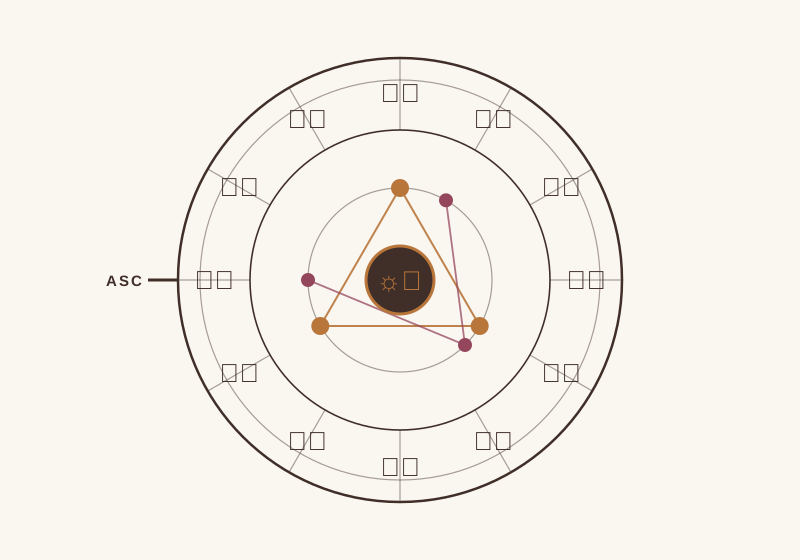
Your Chart Is Split Into 12 Parts
Your chart divides your life into twelve areas — money, work, home and health among them. Each eclipse lands in one of those areas for you, and which one depends on your birth date, time and place.
12 Aug Solar 28 Aug Lunar 2026
We find where each eclipse falls in your own birth chart, and say plainly what it means for you.
Free for 30 days, then $4.99/mo · cancel anytime
Two eclipses, sixteen days apart.
August 2026
A total solar eclipse on Wednesday 12 August, and a lunar eclipse on Friday 28 August. Where each one lands in your birth chart decides what it means for you — and that is set by your birth date, birth time and birth place.
The next eclipse
Total Solar Eclipse · Wed 12 Aug
Shown in your time (UTC) · global timeline — what is overhead depends on where you stand.
Total along a narrow path over Greenland, Iceland and northern Spain; a partial eclipse is visible across much of Europe, parts of eastern Canada and the northern United States, and North Africa. Totality lasts up to 2 minutes 18 seconds.
At the peak: this one opens things. Keep the hour quiet if you can, and notice what you find yourself wanting to start — the easiest dates to act on it are 8 and 17 August.
Partial Lunar Eclipse · Fri 28 Aug
Shown in your time (UTC) · the same moments everywhere on Earth.
Best seen from the Americas — for the US this is the night of Thursday 27 August, with the Moon up coast to coast. Europe and Africa catch it around moonset.
At the peak: this one brings things to a head. Don’t force decisions in the moment — write down what surfaces, and act on the easier days: 23 August and 1 September.
And if it isn’t visible from your city? The reading is the same either way — it is computed from where the eclipse falls in your chart, not from what you can see out the window.
Read from your full birth chart — your birth date, time and place — not just your star sign.
Money, work, home, relationships — we name the one area of your life each eclipse lands in for you.
A score out of 100, from how closely each eclipse lines up with the planets in your own chart. Closer means stronger.
The stretch of days it is most likely to peak for you, and the individual dates worth watching inside it.
Eclipses repeat. We find the last one that hit the same spot in your chart, so you have something real to compare this one to.
Your chart divides your life into twelve areas — money, work, home and health among them. Each eclipse lands in one of those areas for you, and which one depends on your birth date, time and place.
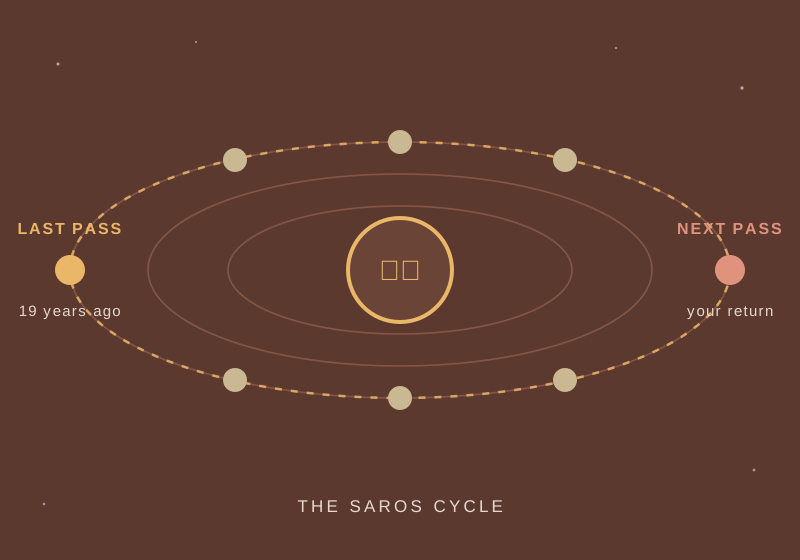
The same eclipse returns to almost the same spot in the sky roughly every 18 years — which is how we find the last time this one reached you, and what it stirred then.
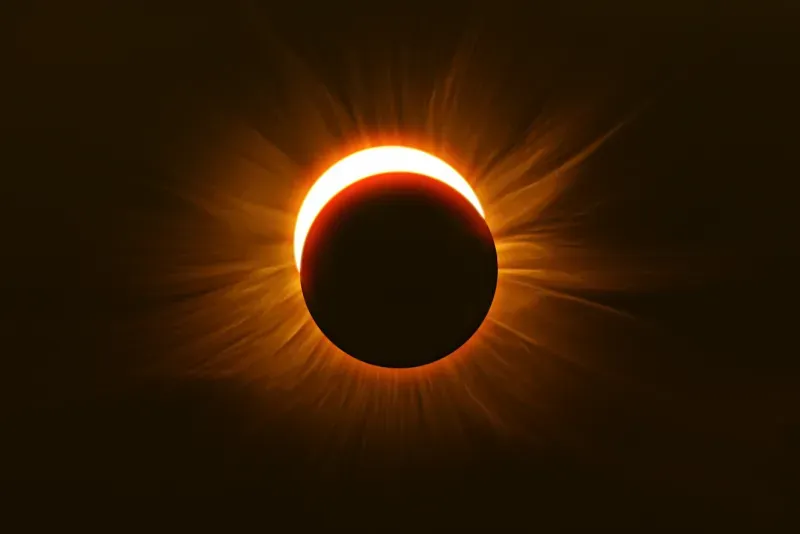
An eclipse's effects usually begin a couple of weeks before the date, come to a head in the fortnight after, and can resurface for up to six months. The date is the middle of it, not the whole of it.
Positions worked out in both systems, side by side, so it reads the same way you do.
Every number comes from your own birth moment and town. Nothing is picked off a list of twelve.
The last time an eclipse hit the same spot in your chart.
All twelve life areas mapped, every planet in your chart placed, and the gap from each one to the eclipse measured to the degree.
How it’s calculated
Nothing in your reading is estimated. Every position behind it is computed, to the degree, from four published astronomical sources — the same ones observatories, planetarium software and almanacs are built on. Here is what each one does for you:
Excerpts from sample readings, computed from real birth details.
“What comes up for review around this time: your income, what you owe and the way you talk to people. The easiest dates to act on are 23 August and 1 September.”
“Marriage, and the one person you deal with face to face. Something new gets set going, and usually faster than you expected. The theme is strongest between 5 and 19 August.”
“Your health, the small obligations you cannot drop, and whatever keeps getting in the way. The theme is strongest between 21 August and 4 September.”
Your reading is free to start. You get 30 days free, and you can cancel before they are up without paying anything. After that it is $4.99 a month, and you can cancel at any time.
Your birth certificate is the best source. Without the hour we can still place your Sun and the planets — but not your rising sign, and that is what decides which part of your life an eclipse lands in. As close as you can get is better than skipping it.
No. Nothing in your reading is written in advance. The positions are computed from your birth moment and city, and the wording follows from those figures — which is why two people born the same day get different readings.
Solar and lunar positions come from the Meeus series, planetary elements from Standish / JPL, and sidereal figures use the Lahiri ayanamsha. Each eclipse is matched to its repeating ~18-year cycle to find its previous pass.
A total solar eclipse on 12 August 2026 and a partial lunar eclipse on 28 August 2026. A solar eclipse opens something; a lunar eclipse brings something to a head. Your reading covers both.
Your name, birth date and birth time never leave your device — the reading is computed in your browser. The one exception is your birth town: we look its coordinates up through a mapping service, because your rising sign and houses cannot be worked out without them. Only the place name is sent, never the rest.
Five details is all we need: your name, email, birth date, birth time and birth town.